Conversion And Conflict
Jonathan Gallagher March/April 2007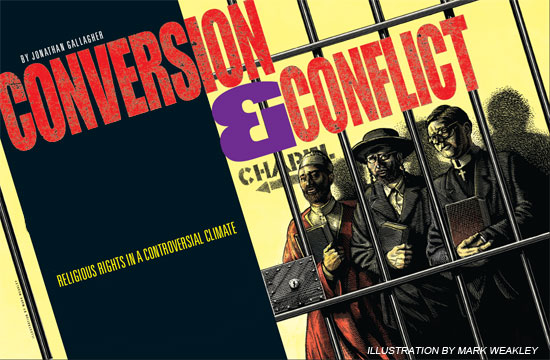
One of the most puzzling of the many questions was why would an English-born man of Jamaican descent become a terrorist? The answer to that question is found in a surprising place: the Feltham Young Offenders' Institution—a prison for youths aged 15 to 21. Reid was an inmate of this and other UK prisons. At Feltham he converted to Islam.
On his release he attended the Brixton mosque, also frequented by Zacarias Moussaoui, the so-called 'twentieth 9/11 hijacker,' before moving on to the more radical mosque at Finsbury Park, home to the extremist cleric Abu Hamza al-Masri. Other al-Qaeda operatives also met there. Through these associations Reid became "radicalized," and as a zealot eager to prove his devotion, trained in camps in Afghanistan and Pakistan.
His suicide mission aboard Flight 63—the "other" airplane plot of 2001—was the end of this process that transmuted a petty criminal into an international terrorist.
J

Are these two narratives isolated instances, or part of a growing—and from the anti-terrorist viewpoint—insidious threat of Islamic proselytism in the jail system? Are we breeding the new generation of terrorists at government expense? Should this threat be tackled immediately and all forms of such proselytism stamped out?
In a surprisingly open press interview, Pascal Maihlos, the director of France's domestic intelligence agency, Renseignements G