
Drawing the Line
Kevin Burton November/December 2026When the Trump administration’s Religious Liberty Commission released its draft report earlier this year, it made the case for a “bridge” rather than a “wall” between church and state. And in doing so, it relied on well-worn narrative: that those who object to the fusion of Christian identity with American political power have always been, by definition, people who stand outside the Christian tradition altogether. They are secular liberals, atheists, Communists, far-left civil liberties organizations, and representatives of non-Christian faith traditions.
This narrative has a long pedigree—and it is wrong.
For more than 160 years Seventh-day Adventists have been among the most committed and theologically grounded critics of Christian nationalism in American public life. Their opposition is not incidental or recent. It is woven into the founding fabric of the denomination and expressed through their journals, their theology, and their institutional advocacy. This includes a remarkable body of political cartoons that rank among the sharpest critiques of religiously coercive government ever produced in the United States.
A Christian Nation
To understand the Adventist critique, one must first understand what they were up against. American Christian nationalism has deep roots, traceable to Scottish Presbyterian Covenanters who began immigrating to America in the seventeenth century. These were ardent believers who insisted that God’s law must govern civil life—that church and state, though distinct in function, both drew their authority from the same divine source and must cooperate to enforce Christian morality. When the U.S. Constitution was ratified without any mention of God, the Covenanters were outraged. As historian Joseph S. Moore has observed: “The loudest and most forceful calls for a Christian America in 1788 and 1789 were made against the Constitution, not in favor of it.”1 In the early republic, Covenanters explicitly denounced religious liberty and toleration as the devil’s seductive tools.
This movement found its most powerful organizational expression after the Civil War. In early 1863, as the nation bled on a hundred battlefields, Protestant leaders gathered in Ohio to call for a constitutional amendment acknowledging God, Jesus, and the Holy Scriptures as the foundation of American law. By 1864 they had organized the National Association to Secure the Religious Amendment of the Constitution, later shortened to the National Reform Association (NRA). Their publication, The Christian Statesman, became the voice of a remarkably influential coalition. By 1876 the NRA had more than 10,000 members, and by the mid-1870s more than 50,000 Americans had signed its petitions—a figure that dwarfed, by comparison, the 8,000 signatures Congress received in 1874 and 1875 on temperance petitions. Supporters included U.S. senators, a future Supreme Court justice, state governors, and leading Protestant evangelists, including Charles Grandison Finney and Dwight L. Moody.2
The NRA’s agenda extended well beyond constitutional language. They campaigned against Sunday violations, Catholic influence in public schools, liquor sales, and what they called “political atheism”—any effort to separate government from Protestant Christianity. Moore further demonstrates that the NRA “planted the seeds of modern American conservatism” by serving as the forerunner to organizations that would eventually produce Project 2025.3
Prophetic Roots
Seventh-day Adventists had been opposing this tendency long before the NRA existed. Their spiritual ancestry lies in the Millerite movement of the 1830s and 1840s, and one of the most formative early influences on Adventist political theology was a Millerite minister named Charles Fitch. In July 1843, Fitch preached in Rochester, New York, what was arguably the most influential sermon of the Millerite movement: “Come Out of Her, My People.”
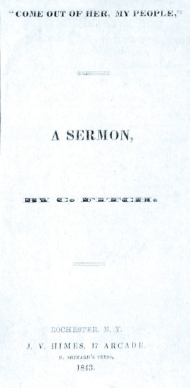
Fitch argued that both the Roman Catholic Church and the Protestant denominations were part of Babylon because they sought earthly dominion by ruling in Christ’s stead. “Each one of these sects,” Fitch wrote, “is willing to rule the world, as the Papists have done, for Christ; but no one of them is willing to have Christ come in person to rule the world for himself.”4 This was not anti-religious sentiment. It was a deeply Christian argument that human institutions—including Christian organizations—become corruptive when they usurp divine authority. To bolster his argument, Fitch saw the institution of slavery as the clearest proof of Protestant tyranny because a man could “sell or buy his fellow-man, and then sit at the communion table, or even minister at the altar of God, and by the mass of Protestant Christendom go unreproved.”5
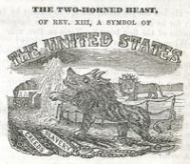
As the young Seventh-day Adventist Church consolidated in the early 1850s, these convictions developed into a formal theological framework. The Adventists came to identify the second beast of Revelation, the one with two horns “like a lamb” that “spoke like a dragon,” as the United States because the nation professed religious and civil liberty (represented by the two lamblike horns) but routinely denied religious and racial minorities these liberties—a hypocrisy that exposed the nation’s dragonic character. This identification crystallized at the moment the Fugitive Slave Act of 1850 was passed, requiring even free states to return escaped enslaved persons. In 1858 Adventist editor and engraver Uriah Smith gave this theology visual form.
Organizing for Liberty
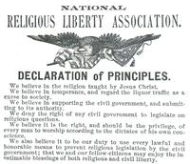
When the National Reform Association launched its campaign to inscribe Christianity into the Constitution, Adventists responded with organized institutional opposition. In 1889 they founded the National Religious Liberty Association—today the International Religious Liberty Association—with a clear Declaration of Principles. This declaration denied “the right of any civil government to legislate on religious questions,” insisted that “it is the right, and should be the privilege, of every [man or woman] to worship according to the dictates of [his or her] own conscience,” and proclaimed that it was “our duty to use every lawful and honorable means to prevent religious legislation by the civil government.”6
The Adventists’ 1897 “Fundamental Principles” statement went further still, declaring that “all religious laws on our civil statute-books are void, as being not only contrary to the Constitution of the United States, in its first amendment, but contrary to the higher constitution of the law of God.”7 This was striking: they grounded their civil liberty not merely in constitutional principle but in their reading of divine law itself. God, they argued, never authorized human governments to enforce religious conformity.
Ellen G. White, the most influential figure in Adventist history, was also unambiguous about these issues. Writing in the Review and Herald in December 1888, she declared: “The National Reform movement has been regarded by some as of so little importance that they have not thought it necessary to give much attention to it. . . . May the Lord forgive our brethren for thus interpreting the very message for this time.”8 For White, opposing Christian nationalist legislation was not a peripheral distraction. It was central to what Adventists believed God was calling them to do.
Cartoons as Witness
Perhaps the most vivid expression of Adventist opposition came through the hundreds of political cartoons published in the denomination’s journal, The American Sentinel (later renamed Liberty), and related publications in the late nineteenth and early to mid-twentieth centuries. These images deserve to be far better known than they are.
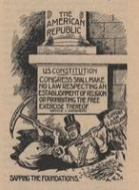
One cartoon depicts the constitutional protection of religious freedom as a great pillar sustaining the American republic. At its base, two crouching “National Reform Association” activists clutch tools, labeled “Political Power” and “Sunday Law Legislation,” as they systematically hack away at the foundation of American government. The cartoon captures the Adventist conviction that religious legislation was not a defense of civilization but a subversion of its constitutional cornerstone.
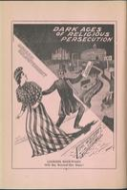
Another cartoon, drawn in stark black and white, shows a “Theological Politician” dragging the female Columbia (representing America) away from a beam of “Modern Enlightenment” and the road marked “Civil and Religious Liberty,” toward a darkened path leading to “Intolerance” depicted by chains, the pillory, stocks, the stake, and ultimately prison and the “Hall of Horrors.” The cartoon draws a direct line between twentieth-century Christian nationalist legislation and the darkest chapters of church history.
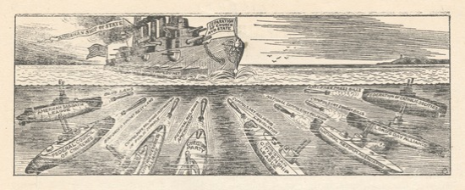
A panoramic cartoon depicts the “American Ship of State” flying the flag of “Separation of Church and State” and protected by a “Constitution Torpedo Net,” under attack by a swarm of submarines. Each torpedo bore an offensive label: “Compulsory Sunday Bills,” “Federal Religious Amendment,” “National Compulsory Religion,” “Anti-Free Press Bills,” and more—and was launched by a coalition of Christian nationalists that the Adventists believed imperiled the republic. Thus, the Adventists presented themselves as defenders of the American constitutional order against widespread coercive forces.
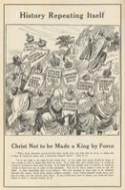
A theologically charged cartoon depicts the same problem. In this image we see robed men with banners representing the same organizations that were also depicted as submarines, such as the American Sabbath League, the National Reform Association, the Federal Council of Churches, and the Christian Citizenship League. These men are marching up a mountain toward Christ, bearing standards labeled with “Compulsory Sunday Bills,” Blue Laws,” “Anti-Free-Press Bills,” and “National Compulsory Religion.” Christ, standing on the summit, turns them away. The cartoon makes a distinctly theological argument: forced religious conformity is not Christianity but its betrayal—a modern repetition of the ancient attempt to make Jesus an earthly political king by redefining His mission.
Beyond National Borders
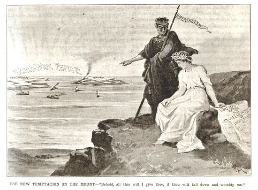
The Adventist critique was not confined to domestic religious legislation. When the United States seized the Philippines after the Spanish-American War of 1898, Adventist cartoonists connected overseas empire-building to the same spirit of coercive dominance they opposed at home. One striking image depicted Columbia (representing America) seated on a clifftop beside the Constitution and the Declaration of Independence, while Satan, a dark figure of “Despotism” and “Imperialism,” gestured toward a “World-Wide Empire” encompassing the Philippines and Hawaii. The caption quoted the gospel account of the devil’s temptation of Christ: “Behold, all this will I give thee, if thou wilt fall down and worship me.” In this manner, the Adventists drew an explicit parallel between American imperialism and the seductions of Satan, arguing that Christian empire abroad was spiritually identical to Christian nationalism at home: both were bids for earthly dominion that betrayed the gospel of Christ.
The Witness Endures
The history of Adventist opposition to Christian nationalism offers a profound corrective to our standard narratives about American religious culture. The Adventists were not secular humanists, not atheists, not members of a non-Christian tradition. They were—and remain—a Bible-centered, Christ-focused Christian denomination that concluded, on specifically theological grounds, that the coercive union of Christianity and governmental power corrupts both. Their argument was not that faith should be absent from public life, but that faith enforced by law ceases to be faith at all. Their political cartoons gave this conviction some of the sharpest visual expression in the history of American religious journalism.
Today their institutional heirs, including Liberty magazine and the International Religious Liberty Association, continue this witness on a global scale. The argument that Adventists have been advancing since the 1840s—that genuine faith cannot be coerced and the God who endowed human beings with freedom of conscience will not honor a government that strips it away—remains as timely as the morning news.
In an era when Christian nationalism has reemerged as a live and organized political force, the long Adventist witness is worth recovering. Not everyone who objects to the merger of church and state is standing outside the faith. Some of the most principled, most persistent, and most theologically coherent voices for religious liberty in American history have always come from within it.9
1 Joseph S. Moore, Founding Sins: How a Group of Antislavery Radicals Fought to Put Christ into the Constitution (Oxford University Press, 2016), p. 55.
2 Ibid., pp. 129-131.
3 Ibid., pp. 144, 153-158 (the quote appears on p. 144).
4 Charles Fitch, “Come Out of Her, My People”: A Sermon (J. V. Himes, 1843), p. 11.
5 Ibid., p. 16. For more on Millerite Adventism and the antislavery movement, see Kevin M. Burton, Apocalyptic Abolitionism: How Millennialists Helped Abolish Slavery and Reform America (New York University Press, 2026).
6 “The National Religious Liberty Association: Declaration of Principles,” The American Sentinel, March 6, 1890, p. 78.
7 “Fundamental Principles of Seventh-day Adventists,” Words of Truth Series, No. 5—Extra, July 1897, p. 8.
8 Ellen G. White, “The Approaching Crisis,” Review and Herald Extra, December 11, 1888, pp. 4, 5.
9 For more information on Adventism and religious liberty, see Dennis Lynn Pettibone, “Caesar’s Sabbath: The Sunday-Law Controversy in the United States, 1879-1892” (Ph.D. diss., University of California Riverside, 1979); Douglas Morgan, Adventism and the American Republic: The Public Involvement of a Major Apocalyptic Movement (University of Tennessee Press, 2001); Jeffrey Rosario, “Seventh-day Adventism and Apocalyptic Political Dissent, 1898-1919” (Ph.D. diss., University of Cambridge, 2022). Also note that Jeffrey Rosario has a forthcoming book that breaks new ground by showing how Adventists strongly opposed Christian nationalism in America, as well as American imperialism abroad, in the late nineteenth and early twentieth centuries.
Article Author: Kevin Burton
Kevin Burton, Ph.D., is director of the Center for Adventist Research at Andrews University, and an assistant professor at the Seventh-day Adventist Theological Seminary, Berrien Springs, Michigan. He is an award-winning historian and the author of numerous academic papers, journal articles, book chapters, and book reviews. His forthcoming book, due out in 2026, is Apocalyptic Abolitionism: How Millennialists Helped Abolish Slavery and Reform America (New York University Press).