The Schoolhouse Debate Returns
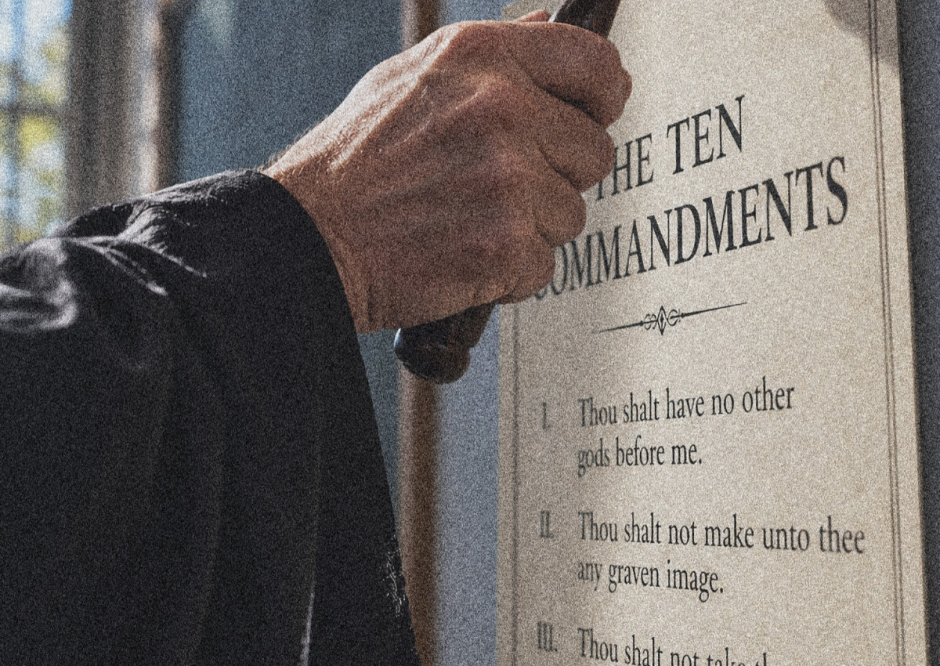
Christopher Hampson November/December 2026The American public schools have long been prominent battlefields in the wars over the role of faith in the public square. Today legal and cultural forces are arraying for a new fight on these hallowed grounds. Lawmakers in Louisiana, Arkansas, Texas, and Alabama have all passed statutes requiring public school teachers to post copies of the Ten Commandments on classroom walls.1 Tennessee allows local boards to post the Ten Commandments but does not mandate it.2 And Texas recently added passages from the Bible to its required readings for grades K-12.3 These developments may portend shifts in the Supreme Court’s First Amendment jurisprudence and should prompt some serious soul-searching for followers of Jesus.
The Legal Test
Lawsuits over the new laws are likely headed to the Supreme Court, which for several years has been reworking the legal doctrines flowing from the establishment clause and the free exercise clause of the U.S. Constitution. In 2022, in Carson v. Makin, the Supreme Court decided that Maine couldn’t restrict religious schools from receiving tuition assistance that was available to other schools.4 The same year, in Kennedy v. Bremerton School District, the Supreme Court signed off on a football coach’s post-game prayers on the 50-yard line, rebuking the school for trying to avoid establishment. Along the way, the Court threw out a beleaguered “balancing test” from the 1970s, announcing that the new formula for unlawful establishment would look to the nation’s history and tradition.5
Those cases, particularly Kennedy, have encouraged policymakers in such states as Texas to “bring God back” into public schools. But it’s not clear that the Supreme Court will sign off on initiatives such as assigning Bible reading or requiring the Ten Commandments on classroom walls. Certainly the Supreme Court has signaled disapproval of strict separationism and said that states must remain studiously neutral as between secular and religious people and institutions. It has also held that states cannot step on someone’s free exercise rights out of an abundance of caution not to violate the establishment clause.6 But when it comes to the Decalogue, the Court would have to overturn its own decision in 1980 in Stone v. Graham, which ruled that Kentucky could not require the posting of the sacred text in public school classrooms.7 That outcome seems unlikely. After all, the posters are not the “free exercise” of an individual teacher or official, but a centralized government message. And as Professor Nathan Chapman has pointed out: “The walls of school classrooms are festooned with ‘stuff we expect you to learn’ ”—suggesting that requiring an expressly religious text is more coercive than the states want to admit.8
The Court is more likely, however, to allow Texas to add religious texts to its required reading list. After all, the courts have long suggested that teaching about religion is perfectly constitutional, so long as the teachers do not evangelize.9 And the passages Texas has selected seem like decent philosophical and literary picks, from the story of David and Goliath in second grade to the parting of the Red Sea in fifth grade to the book of Job in tenth grade.10
The texts that did not make Texas’s list are curious, though. Starting in 2030, students will read The Lion, the Witch, and the Wardrobe, by C. S. Lewis, but not any of the Gospel texts that are the source for Lewis’s allegory. Students will read the parable of the prodigal son (Luke 15:11-32) but not the parable of the good Samaritan (Luke 10:25-37). And while students will read about the parting of the Red Sea, Texas did not assign the Ten Commandments. What could Texas mean by requiring the Ten Commandments as passive posters but not required reading? And why assign the Beatitudes (Matthew 5:1-12) in freshman-year English but not post them on the wall?
Whose Tradition?
These bills will force the Supreme Court, and all of us, to grapple with the question of what to do when states go beyond neutrality to recognize and celebrate the role of particular religions in the history and tradition of the country. As I pointed out elsewhere, it is only the Ten Commandments that the states are requiring, not the Four Noble Truths, the Thirteen Articles of Faith, or the Shahada.11 And it is almost entirely passages from the Old and New Testaments that Texas is requiring teachers to cover, not the life of the Buddha or the story of Solomon and the Ants. In fact, the Texas Board of Education recently removed stories about Anansi and Hercules from the schedule, scrubbing any pretense of religious diversity from the required reading list.12 At the same time, the city of Hartford is working to develop optional materials to help students learn about Arab and Islamic civilizations.13
Recently a thin majority of the Fifth Circuit, which hears appeals from Texas, blessed the Decalogue on classroom walls but dodged the deeper issues, saying that federal judges are not theologians and are unable to weigh in on whether the text of the Ten Commandments was sectarian.14 The touchstone for establishment, the court ruled, is what the Founders would have recognized from their experiences in England and the colonies: forced church attendance, required tithing, and the like.15 Both of those arguments make little sense to me. If lawmakers can do enough theology to impose religion, then surely judges can do enough theology to decide whether that imposition violates the establishment clause. And just because the Founders faced sharper, bolder forms of establishment does not mean that the word “establishment” is limited to those practices. The Constitution bars newer, subtler forms of establishment, too.16
The Christian Cost
Ultimately, the Supreme Court will decide the legal rules. But these legal battles raise even tougher questions for followers of Jesus Christ. Might we win the battle and lose our souls? Consider this: One of the Ninth Circuit judges who had ruled against Coach Kennedy pointed out that “no case law requires that a high school teacher . . . jump into the nearest broom closet in order to engage in private prayer.”17 Christians in the United States should be grateful that we live in a country with a strong tradition of religious freedom. But note the irony: a certain first-century Rabbi taught His disciples not to pray in public to be seen by others, but to “enter into thy closet” and “shut thy door” to pray.18 In this and other ways, the effort to get God “back into schools” comes at a cost.
The first price is the redaction of the Holy Bible. As I (and many others) have pointed out, the version of the Ten Commandments that Texas, Louisiana, Arkansas, Alabama, and Tennessee have endorsed is not actually the biblical text. For example, in Scripture God introduces Himself in Scripture this way: “I am the Lord your God, who brought you ought of the land of Egypt, out of the house of slavery.”19 In the G.I. version, though, the text says only, “I am the Lord Thy God.” God’s abolitionist nature is stripped away.20
The second price is honesty about the power of God’s Word. Some policymakers and judges are now insisting that the text of the Ten Commandments is “passive.”21 Similarly, the handful of stories now required to be taught in the Texas public school curriculum must be taught as literature or comparative religion, not as invitations to a living faith in Jesus Christ. But Christians do not believe that God’s Word is passive or merely literary. Why should we seek to reduce the Bible to those categories?
God Never Left
This drive is part of a renewed effort to “bring God back into public schools.” The campaign goes back decades. As I went through the public school system in the 1990s and early 2000s in Cranston, Rhode Island, I heard adults at my evangelical church lament that “they took God out of public schools,” referring to court decisions that came down in the 1960s against mandatory Bible reading and official school prayer.22 I do not mean to minimize the feelings of loss, which are deeply and sincerely felt.23 But the sentiment seems to cut against what I learned from my parents and in church. My parents taught me from an early age that Jesus said, “Where two or three gather in my name, there am I with them.”24 I grew up with the story of Shadrach, Meschach, and Abednego, who set themselves apart in the Babylonian royal court as a close group of friends.25 I also grew up watching the animated VeggieTales version of the story, called “Rack, Shack, & Benny,” on Sunday nights.26
The God we worship doesn’t need numbers, power, or prominence. And prayers do not need to be over the intercom to be powerful or effective. I prayed over my lunch every day (and over a few tests), attended a Bible study before the school day started, and even led group prayer outside at the flagpole, part of the See You at the Pole (“SYATP”) movement. In 2001 my brother was organizing a SYATP prayer event at the middle school for mid-September. After the terrorist attacks on the World Trade Center, dozens and dozens of students, parents, faculty, and staff turned out to pray at the flagpole. We didn’t know that September 11 would happen a few days before the prayer gathering—or that the national head count for the 2001 SYATP would eventually exceed 3 million people.27
God never left the American public schools. More important, what kind of God can be taken out of a place? That sounds more like Rachel’s household gods in Genesis 31, which she hid under a saddle from her father, Laban.28 Is God an idol of wood or stone that could be moved in or out of a place?29 And why are we trying to honor God by doing the opposite of what Jesus teaches?
To be clear, the legacy of free exercise is an important one in the United States, and Christians should stand up for anyone who wishes to exercise that right by praying in public or bringing religious items into public schools, whether they call themselves Christians or not. But Christians should be cautious not to claim that God is behind imposing our faith by force.30 And we should be careful not to let these constitutional battles reshape our faith.
1 See, for example, Christopher D. Hampson, “The Ten Commandments, Stripped of Slavery, Exodus & Jubilee,” Washington and Lee Law Review Online 83 (2026): 228; see also Alabama Senate Bill 99, 2026 Regular Session (2026) (enacted).
2 See Tennessee House Bill 47, 114th General Assembly (2025–2026) (enacted).
3 See Texas State Board of Education, “Literary Lists Amendments,” https://sboe.texas.gov/state-board-of-education/ch110-and-ch128-figures-approved-cofb.pdf; Sarah Mervosh, “Texas Book List: See What Students Will Be Required to Read,” New York Times, July 20, 2026.
4 596 U.S. 767 (2022).
5 597 U.S. 507, 535 (2022) (overruling Lemon v. Kurtzman, 403 U.S. 602 [1971]).
6 596 U.S. 767, 781 (2022).
7 449 U.S. 39 (1980).
8 See Nathan Chapman, “Nathan v. Alamo Heights Independent School District,” Canopy Forum, May 21, 2026.
9 For example, the Third Circuit recently upheld a middle school program that taught about various world religions, including Islam, Buddhism, and Christianity, noting that it formed part of “an appropriate study of history, civilization” and “comparative religion.” See Hilsenrath v. School District of Chathams, 136 F.4th 484, 492, 493 (3d Cir. 2025).
10 See note 2.
11 See Christopher D. Hampson, “For the Word of God Is Posted and Passive,” Canopy Forum, May 22, 2026.
12 See Gerald McDermott, Anansi the Spider (Henry Holt and Company, 1972) (“For Ashanti People, Nyame Is the God of All Things”); William J. Bennett, ed., The Children’s Book of Virtues (Simon & Schuster, 1995), p. 52 (describing how a wagoner got stuck in the mud and began “calling loudly at intervals upon Hercules for assistance [when] the god himself appeared”).
13 See, for example, Bonnie Kristian, “Texas and Connecticut Chart Different Paths on Religion in Public Schools,” Christianity Today, August 10, 2026; Madhiha Anis and David Katibah, “Connecticut Legislation Aims to Expand Islam Education in Public Schools,” Religion News Service, August 3, 2026.
14 Nathan v. Alamo Heights Independent School District, 173 F.4th 576, 605 (5th Cir. 2026).
15 Ibid., p. 602.
16 Justice Amy Coney Barrett has reinforced this idea in the context of the Court’s Second Amendment jurisprudence, but it applies here, too. See United States v. Rahimi, 602 U.S. 680, 740 (2024) (Barrett, J., concurring) (“Historical regulations reveal a principle, not a mold.”).
17 Kennedy v. Bremerton School District, 991 F.3d 1004, 1025 (9th Cir. 2021) (Christen, J., concurring), overruled by 597 U.S. 507.
18 See Matthew 6:6.
19 Exodus 20:2, NASB; Deuteronomy 5:6, NASB. Scripture quotations marked NASB are from the New American Standard Bible, copyright © 1960, 1971, 1977, 1995, 2020 by The Lockman Foundation. All rights reserved.
20 See Hampson, “The Ten Commandments, Stripped of Slavery, Exodus & Jubilee,” pp. 232, 234–237; see also Christopher D. Hampson, “The Spirit of Jubilee,” BYU Law Review 51 (2026): 1251 (discussing the importance of the jubilee texts in American legal and political history).
21 See Hampson, “For the Word of God Is Posted and Passive.”
22 See Engel v. Vitale, 370 U.S. 421 (1962) (holding that state-composed prayer in public schools violates the establishment clause); Abington School District v. Schempp, 374 U.S. 203 (1963) (holding that mandatory Bible verse readings and the Lord’s Prayer violate the establishment clause).
23 Professor Corinna Barrett Lain said that Engel “is widely regarded as one of the most unpopular decisions in Supreme Court history,” in part because journalists widely reported the decision as outlawing all prayer in public schools, even if personal and voluntary. Corinna Barrett Lain, “God, Civic Virtue, and the American Way: Reconstructing Engel,” Stanford Law Review 67 (2015): 479, 481; see also p. 507 (“The vitriolic attacks on Engel [and the Supreme Court for deciding it] were unlike anything the nation had ever seen”).
24 Matthew 18:20, NIV. Bible texts credited to NIV are from the Holy Bible, New International Version. Copyright © 1973, 1978, 1984, 2011 by Biblica, Inc. Used by permission. All rights reserved worldwide.
25 See Daniel 1; 3.
26 See Big Idea, VeggieTales, “Rack, Shack & Benny” (1995). I analyzed the bankruptcy of Big Idea and its sale to Netflix in Christopher D. Hampson, “Bankruptcy & the Benefit Corporation,” American Bankruptcy Law Journal 96 (2022): 93.
27 See Benjamin J. Young, “See You at the Pole: Evangelicals, Public Schools, and ‘Student-Initiated’ School Prayer in 1990s America,” Modern American History 6 (2023): 156, 175.
28 Genesis 31:33–35.
29 See Deuteronomy 4:28.
30 As I’ve argued elsewhere, this tactic might, ironically, violate the third commandment. See Hampson, “For the Word of God Is Posted and Passive.”
Article Author: Christopher Hampson
Christopher D. Hampson, J.D., M.T.S., is an associate professor at the University of Florida Levin College of Law whose scholarship explores bankruptcy, the First Amendment, and the intersection of law and religion.